Choosing reliable Lifting Conveyor Belts manufacturers in China requires more than comparing prices or catalog photographs. Buyers should examine manufacturing experience, belt construction, lifting height, loading capacity, splice quality, and after-sales support. These details often decide whether a belt performs smoothly or stops beneath a heavy load.
Conveyor engineer and author David G. Yokley once observed, “A conveyor system is only as reliable as its weakest component.” This practical warning matters when reviewing Chinese suppliers. A strong manufacturer should provide clear technical drawings, material specifications, inspection records, and realistic delivery information. Certifications can support credibility, but they should not replace independent verification.
Look closely.
This article introduces leading Chinese manufacturers associated with Lifting Conveyor Belts and compares their capabilities for mining, ports, warehouses, recycling plants, and general bulk-material handling. The discussion considers rubber quality, steel-cord or fabric reinforcement, cleat design, inclination control, abrasion resistance, and customization experience. It also examines whether suppliers offer installation guidance, replacement parts, and responsive technical service.
No ranking is perfect.
Company reputations change, product lines evolve, and published information may contain gaps. Buyers should request recent project references and test samples before making a final decision. Factory audits can reveal details that websites rarely show, including curing consistency, storage conditions, and quality-control discipline. The most suitable supplier may not be the largest company. It may be the manufacturer that understands your material, operating temperature, conveyor geometry, and maintenance limits.
What Is a Lifting Conveyor Belt and How Does It Work?
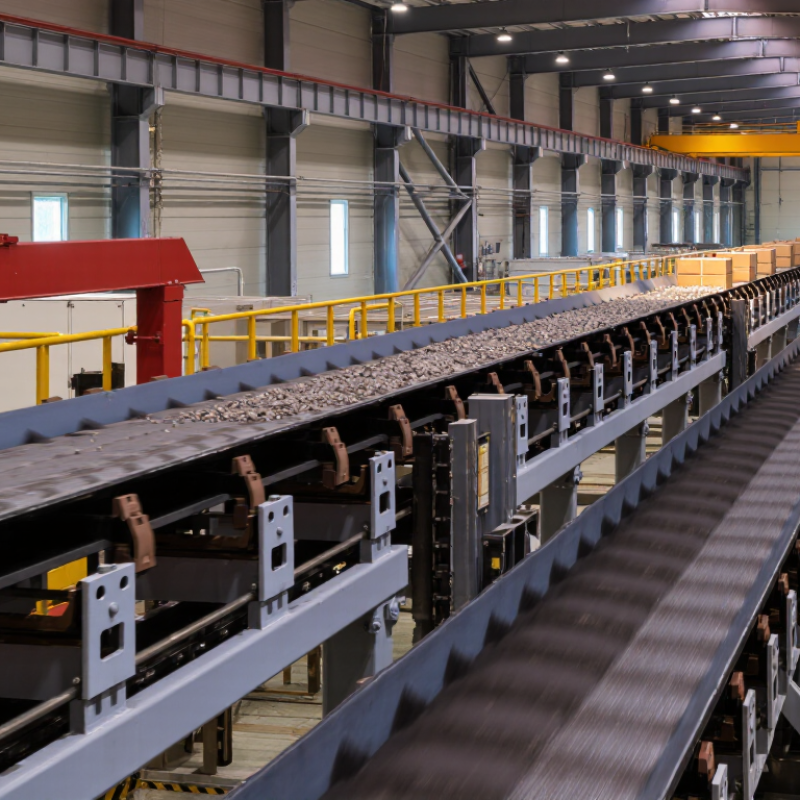
A lifting conveyor belt moves materials between different heights. It uses a continuous belt, powered by an electric motor and drive pulley. The belt travels over rollers or a guided frame, carrying cartons, bags, parts, or bulk materials upward. Unlike a flat conveyor, its incline requires stronger traction and careful load control.
A typical system includes a cleated or textured belt. Cleats prevent products from sliding backward on steep sections. Side guards reduce spillage, especially when conveying loose materials. Sensors can stop the belt if a product jams or the belt shifts. In practical equipment checks, belt tension often affects performance more than expected. Too little tension causes slipping, while excessive tension increases bearing wear.
Reliable manufacturers in China usually customize the frame, belt width, incline angle, and lifting height. Buyers should request load tests, safety documentation, and clear maintenance instructions. A suitable design must match product weight, surface condition, speed, and available floor space. I have found that a visually strong conveyor can still perform poorly when its transfer points are badly aligned. The details matter. Regular cleaning also protects the belt and improves tracking. Yet no design is perfect; changing product sizes may require later adjustments.
What Are the Top Lifting Conveyor Belt Manufacturers in China?
Lifting conveyor belts transport bulk materials or packaged products to a higher elevation. Cleats, sidewalls, or pockets help prevent load rollback, while the drive pulley supplies continuous traction. The chart shows typical conveying-angle ranges for common lifting conveyor configurations; values are engineering reference ranges and are not company-specific performance claims.
Conventional troughed belts are generally used for lower inclines, while cleated, sidewall, and pocket belts support steeper lifting applications. Actual performance depends on material characteristics, belt design, cleat height, loading rate, belt tension, and safety requirements.
What Criteria Define a Leading Chinese Conveyor Belt Manufacturer?
A leading Chinese lifting conveyor belt manufacturer proves capability through consistent engineering, not attractive brochures. Look for experience with steep-angle conveying, heavy loads, and abrasive materials. The manufacturer should explain belt construction, tensile strength, cover grades, splice methods, and operating limits in clear technical language.
Reliable suppliers maintain controlled production records. Ask for material traceability, dimensional checks, adhesion tests, and fatigue testing. Independent inspection reports can strengthen confidence. Factory experience matters too. A manufacturer that has supported mines, ports, or processing plants understands dust, moisture, impact, and misalignment. However, experience claims need evidence, such as project references, test data, and practical maintenance records.
Tips: Request a sample belt section. Check its surface, edge finish, fabric alignment, and rubber consistency. Ask how quickly replacement parts and technical support arrive. Do not judge quality by price alone. A cheap belt may create longer downtime. Still, expensive equipment is not automatically better; I would compare measurable performance before deciding.
Strong manufacturers also improve designs after field feedback. They may adjust cover formulas, pulley recommendations, or splice procedures for local conditions. This practical attitude shows professional judgment. Certification helps, but certificates should match the actual product and production site. Communication is another useful test. Engineers should answer specific questions without hiding behind general promises. Some suppliers may overlook small details, such as storage temperature or installation tension. Those details can shorten belt life noticeably.
Which Chinese Manufacturers Specialize in Lifting Conveyor Belts?
Chinese manufacturers specializing in lifting conveyor belts usually fall into three groups: heavy-duty conveyor OEMs, rubber-belt producers, and engineering integrators.
Their products serve mines, ports, warehouses, cement plants, and food-processing lines. A 2024 Research and Markets assessment projected steady global conveyor-belt growth through 2028, with demand supported by mining automation and warehouse expansion. That growth is visible in Chinese factories. Many now offer cleated belts, sidewall belts, bucket-style lifts, and inclined modular systems.
The strongest suppliers do more than assemble a belt and motor.
They calculate belt tension, pulley diameter, loading angle, and vertical lift height before production. For a dusty quarry, buyers should request abrasion testing, splice records, and a tracking test under load. For warehouse lifting, a manufacturer should show emergency-stop design, guarding, and stable speed control. Technical alignment with ISO 14890 and relevant DIN belt specifications is useful evidence, although certification alone does not prove field performance. Ask for site references.
A practical factory visit may reveal more than a polished catalogue.
Look for rubber mixing records, steel-cord inspection, sidewall bonding, and a measured test run with material on the belt. Small gaps matter. Some suppliers still underestimate noise, belt sway, or cleaning access. That is where buyers should remain skeptical. A 2023 industry analysis by Grand View Research identified automation and material-handling upgrades as important market drivers, but real installations remain highly site-dependent. The best Chinese manufacturers adapt the lift, not merely the product label.
How Do Their Products and Services Compare?
What Are the Top Lifting Conveyor Belt Manufacturers in China?
China’s leading lifting conveyor belt manufacturers differ mainly in engineering depth, service response, and testing discipline. According to Grand View Research, the global conveyor belt market was valued at approximately US$5.6 billion in 2023. This demand is pushing suppliers to improve vertical conveying systems, not merely reduce prices.
Product comparisons should begin with belt construction. Strong suppliers offer steel-cord or reinforced fabric belts, molded cleats, stable sidewalls, and abrasion-resistant covers. These details matter on steep lifts carrying crushed stone, grain, or boxed goods. A reliable factory should provide belt tensile data, splice instructions, pulley compatibility, and documented quality checks. Some suppliers offer laboratory reports, but the testing scope can be unclear. Ask precise questions.
Service quality often separates export-ready manufacturers from ordinary workshops. Better suppliers review loading points, incline angles, belt speed, and ambient temperature before quoting. They also provide layout drawings, installation guidance, spare-part lists, and remote troubleshooting. A 2024 report by Mordor Intelligence identifies automation and material-handling expansion as major conveyor market drivers, increasing the need for responsive technical support. Lead time is another practical measure. Stocked components may shorten delivery, while custom cleats and special rubber compounds require longer production. Communication still fails sometimes. Confirm every tolerance in writing.
Price deserves caution. A cheaper belt may use thinner covers or less consistent bonding, creating premature slippage and maintenance costs. Buyers should compare total operating cost, warranty terms, inspection records, and replacement support—not only the initial quotation.
How Can Buyers Select the Right Chinese Manufacturer?
Selecting a Chinese lifting conveyor belt manufacturer requires more than comparing online prices. Buyers should examine engineering capability, production control, and after-sales support. Ask for drawings showing belt width, lifting height, incline angle, load capacity, and operating speed. A serious manufacturer should explain frame materials, belt structure, motor protection, and emergency-stop design clearly.
Request a factory audit, even through a live video call. Check welding quality, pulley alignment, belt tracking, and final testing records. Ask for references from projects using similar materials and working conditions. Independent inspections can confirm dimensions and electrical components. A polished factory tour is useful, but it does not prove long-term reliability. This is where many buyers become too confident.
Tips:
Prepare one detailed specification sheet. Compare warranty terms, spare-part availability, delivery dates, and installation support. Ask who handles faults after commissioning. Require a sample test with your actual product, if possible. Observe slipping, noise, dust accumulation, and belt tension during operation. Do not accept vague claims about “high quality.” Written tolerances and measurable test results are stronger evidence. Price still matters, but an unusually low quotation may hide thinner steel, weaker motors, or limited service. Buyers should also confirm export documents, payment safeguards, and communication responsibilities before production begins. Small omissions often become expensive delays.
Conclusion
This article explains what Lifting Conveyor Belts are, how they transport materials between different elevations, and why features such as cleats, sidewalls, belt strength, and stable traction are essential for safe and efficient operation. It also examines the qualities that define a leading Chinese conveyor belt manufacturer, including material consistency, engineering capability, production capacity, quality control, customization options, and after-sales support.
The article compares manufacturers that specialize in Lifting Conveyor Belts by considering their product designs, load-handling performance, durability, application range, delivery reliability, and service capabilities. Finally, it provides practical guidance for buyers choosing a suitable supplier. Key considerations include the type of material being conveyed, lifting angle, belt dimensions, working environment, required capacity, certification needs, total cost, and long-term maintenance support. This approach helps buyers make a balanced decision based on technical requirements, operational goals, and supplier reliability.

 Boao Rubber